
IgG is a monomeric immunoglobulin, built of two heavy chains gamma and two light chains. Each molecule has two antigen binding sites. This is the most abundant immunoglobulin and is approximately equally distributed in blood and in tissue liquids, constituting 75% of serum immunoglobulins in humans. This is the only isotype that can pass through the human placenta, thereby providing protection to the fetus in its first weeks of life before its own immune system has developed. It can bind to many kinds of pathogens, for example viruses, bacteria, and fungi, and protects the body against them by complement activation (classic pathway), opsonization for phagocytosis and neutralisation of their toxins. There are 4 subclasses: IgG1 (66%), IgG2 (23%), IgG3 (7%) and IgG4 (4%).
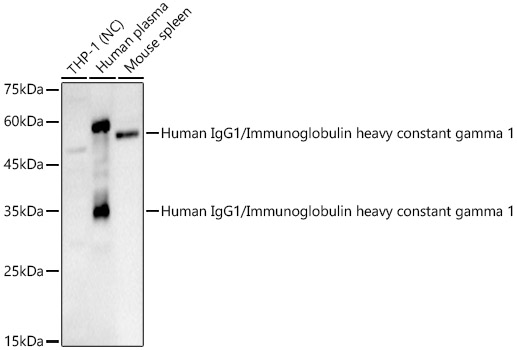
Human IgG1/Immunoglobulin heavy constant gamma 1 Rabbit Polyclonal Antibody
Price range: $80.00 through $350.00
| Pack Size | 100ul, 1ml, 20ul |
|---|---|
| Applications | ELISA, WB |
| Host Species | Rabbit |
| Ig Isotype | IgG |
| Antibody Type | Polyclonal Antibody |
| Organism Species | Human |
| Concentration | – |
| Product Synonyms | Human IgG1/Immunoglobulin heavy constant gamma 1 |
| Observed Mol Wt | 44kDa |
| Immunogen (Antigen) | Recombinant protein |
| Format | Liquid |
| Buffer Formulation | 50% glycerol, PBS with 0.05% proclin300, pH7.3 |
| Reactivity | Human, Mouse |
| Uniprot ID | 3500 |
| Gene ID | P01857 |
| Purification | Antigen-specific affinity chromatography followed by Protein A affinity chromatography |
| Usage | For Research Use Only. Not for diagnostics or human use. |
| Shelf Life | 12 months at time of shipping |
| Shipping | Shipped in Dry Ice at -20 Degree Celsius |
| Storage | Store at -20 Degree Celsius. It is recommended to aliquot and store to avoid repeated freeze-thaw as it affects the stability of the antibody. |
| Research Areas | Immunology |
| KD/KO Validated | KD Validated |
| Disclaimer | The data indicated herein are as indicated and validated in our laboratory. These reagents are for research use only and not for in-vitro diagnostics or human use. |
Related Products
-
![CAT1 Rabbit Polyclonal Antibody [KD Validated]](https://www.kinesisdx.com/wp-content/uploads/2025/05/A25422_N32165-5_WB_01-370x444.jpg) Sale
Sale
-
![EGFR Rabbit Polyclonal Antibody [KD Validated]](https://www.kinesisdx.com/wp-content/uploads/2025/05/A11576_Q722_WB_01-370x444.jpg) Sale
Sale
-
![EGFR Rabbit Polyclonal Antibody [KD Validated]](https://www.kinesisdx.com/wp-content/uploads/2025/05/A21740_aN1626-7_WB_01-370x444.jpg) Sale
Sale
-
![COX7A2L Rabbit Polyclonal Antibody [KD Validated]](https://www.kinesisdx.com/wp-content/uploads/2025/05/A23681_N25896-4_WB_01-370x444.jpg) Sale
Sale
-
 Sale
Sale
-
 Sale
Sale
Reviews
There are no reviews yet.