
The WNT gene family consists of structurally related genes which encode secreted signaling proteins. These proteins have been implicated in oncogenesis and in several developmental processes, including regulation of cell fate and patterning during embryogenesis. This gene is a member of the WNT gene family. It is very conserved in evolution, and the protein encoded by this gene is known to be 98% identical to the mouse Wnt1 protein at the amino acid level. The studies in mouse indicate that the Wnt1 protein functions in the induction of the mesencephalon and cerebellum. This gene was originally considered as a candidate gene for Joubert syndrome, an autosomal recessive disorder with cerebellar hypoplasia as a leading feature. However, further studies suggested that the gene mutations might not have a significant role in Joubert syndrome. This gene is clustered with another family member, WNT10B, in the chromosome 12q13 region.
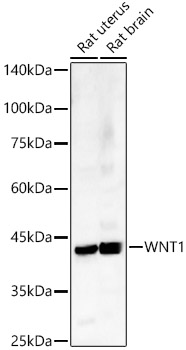
| Pack Size | 100ul, 1ml, 20ul |
|---|---|
| Applications | ELISA, IF/ICC, IHC-P, WB |
| Host Species | Rabbit |
| Ig Isotype | IgG |
| Antibody Type | Polyclonal Antibody |
| Organism Species | Human |
| Product Synonyms | WNT1 |
| Observed Mol Wt | 41kDa |
| Alternative Names | INT1; OI15; BMND16; WNT1 |
| Immunogen (Antigen) | Recombinant protein |
| Format | Liquid |
| Buffer Formulation | 50% glycerol, PBS with 0.09% Sodium azide, pH7.3 |
| Reactivity | Human, Mouse, Rat |
| Uniprot ID | 7471 |
| Gene ID | P04628 |
| Purification | Antigen-specific affinity chromatography followed by Protein A affinity chromatography |
| Usage | For Research Use Only. Not for diagnostics or human use. |
| Shelf Life | 12 months at time of shipping |
| Shipping | Shipped in Dry Ice at -20 Degree Celsius |
| Storage | Store at -20 Degree Celsius. It is recommended to aliquot and store to avoid repeated freeze-thaw as it affects the stability of the antibody. |
| Research Areas | Cancer, Cell Biology, Immunology |
| KD/KO Validated | KD Validated |
| Disclaimer | The data indicated herein are as indicated and validated in our laboratory. These reagents are for research use only and not for in-vitro diagnostics or human use. |
Related Products
-
![Bcl9 Rabbit Polyclonal Antibody [KD Validated]](https://www.kinesisdx.com/wp-content/uploads/2025/05/A25229_N31416-5_WB_01-370x444.jpg) Sale
Sale
-
![Bcl-XL Rabbit Polyclonal Antibody [KD Validated]](https://www.kinesisdx.com/wp-content/uploads/2025/05/A22241_aP7267_KO-WB_01-370x444.jpg) Sale
Sale
-
![CAT1 Rabbit Polyclonal Antibody [KD Validated]](https://www.kinesisdx.com/wp-content/uploads/2025/05/A25422_N32165-5_WB_01-370x444.jpg) Sale
Sale
-
![EGFR Rabbit Polyclonal Antibody [KD Validated]](https://www.kinesisdx.com/wp-content/uploads/2025/05/A11576_Q722_WB_01-370x444.jpg) Sale
Sale
-
![COX IV Rabbit Polyclonal Antibody [KD Validated]](https://www.kinesisdx.com/wp-content/uploads/2025/05/A22871_N14734-4_KO-WB_01-370x444.jpg) Sale
Sale
-
![CLIC1 Rabbit Polyclonal Antibody [KD Validated]](https://www.kinesisdx.com/wp-content/uploads/2025/05/A23677_N26852-4_IF_01-370x444.jpg) Sale
Sale
Reviews
There are no reviews yet.