
Transcription factor acting as a positive regulator in the ethylene response pathway). Required for the inhibition of root growth by ethylene in etiolated seedlings. Functions upstream of the auxin biosynthetic gene YUCCA8 and directly activates its expression . Functions downstream of the ethylene signaling factor EIN2 in disease resistance against the rice blast fungus (Magnaporthe oryzae. Binds directly to the promoters of the NADPH oxidases RBOHA and RBOHB, and the jasmonate biosynthetic gene OPR4 to activate their expression during fungal infection. May enhance disease resistance by facilitating reactive oxygen species (ROS) generation and jasmonate biosynthesis with subsequent phytoalexin accumulation during Magnaporthe oryzae infection. Acts as negative regulator of salt tolerance . During salt stress, activates the cation transporter HKT1, which mediates increased sodium uptake in roots, and contributes to sodium accumulation and salt toxicity. Binds directly to the DNA sequence 5′-TGTTACAAATACC-3′ in the promoter of the GA20OX2 gene to activate its expression at the transcriptional level during ethylene signaling. Possesses transactivation activity in protoplasts.
| Pack Size | 100ul, 1ml, 20ul |
|---|---|
| Applications | ELISA, WB |
| Host Species | Rabbit |
| Ig Isotype | IgG |
| Antibody Type | Polyclonal Antibody |
| Organism Species | Oryza sativa |
| Concentration | – |
| Product Synonyms | OsEIL1 |
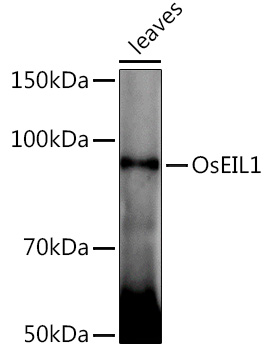
| Observed Mol Wt | 71kDa |
| Alternative Names | EIL1; MHZ6; EIL1A; OsEIL1; OsEIL1a; OsJ_10672 |
| Immunogen (Antigen) | Recombinant protein |
| Format | Liquid |
| Buffer Formulation | 50% glycerol, PBS with 0.01% thimerosal, pH7.3 |
| Reactivity | Oryza sativa |
| Uniprot ID | 107276358 |
| Gene ID | Q10M41 |
| Purification | Antigen-specific affinity chromatography followed by Protein A affinity chromatography |
| Usage | For Research Use Only. Not for diagnostics or human use. |
| Shelf Life | 12 months at time of shipping |
| Shipping | Shipped in Dry Ice at -20 Degree Celsius |
| Storage | Store at -20 Degree Celsius. It is recommended to aliquot and store to avoid repeated freeze-thaw as it affects the stability of the antibody. |
| Research Areas | Cell Biology, Developmental Biology, Immunology |
| KD/KO Validated | KD Validated |
| Disclaimer | The data indicated herein are as indicated and validated in our laboratory. These reagents are for research use only and not for in-vitro diagnostics or human use. |
Related Products
-
![CAT1 Rabbit Polyclonal Antibody [KD Validated]](https://www.kinesisdx.com/wp-content/uploads/2025/05/A25422_N32165-5_WB_01-370x444.jpg) Sale
Sale
-
![RHOT1/MIRO1 Rabbit Polyclonal Antibody [KD Validated]](https://www.kinesisdx.com/wp-content/uploads/2025/05/A22551_N1681810-11_WB_01-370x444.jpg) Sale
Cell Biology
Sale
Cell BiologyRHOT1/MIRO1 Rabbit Polyclonal Antibody [KD Validated]
Price range: $100.00 through $430.00 -
![Bcl-XL Rabbit Polyclonal Antibody [KD Validated]](https://www.kinesisdx.com/wp-content/uploads/2025/05/A22241_aP7267_KO-WB_01-370x444.jpg) Sale
Sale
-
![CTCF Rabbit Polyclonal Antibody [KD Validated]](https://www.kinesisdx.com/wp-content/uploads/2025/05/A18627_N6060-4_KO-WB_01-370x444.jpg) Sale
Sale
-
![ABCG2 Rabbit Polyclonal Antibody [KD Validated]](https://www.kinesisdx.com/wp-content/uploads/2025/05/A23066_N21785-6_WB_01-370x444.jpg) Sale
Sale
-
![EIF4B Rabbit Polyclonal Antibody [KD Validated]](https://www.kinesisdx.com/wp-content/uploads/2025/05/A25045_N31618-4_WB_03-370x444.jpg) Sale
Sale
Reviews
There are no reviews yet.