
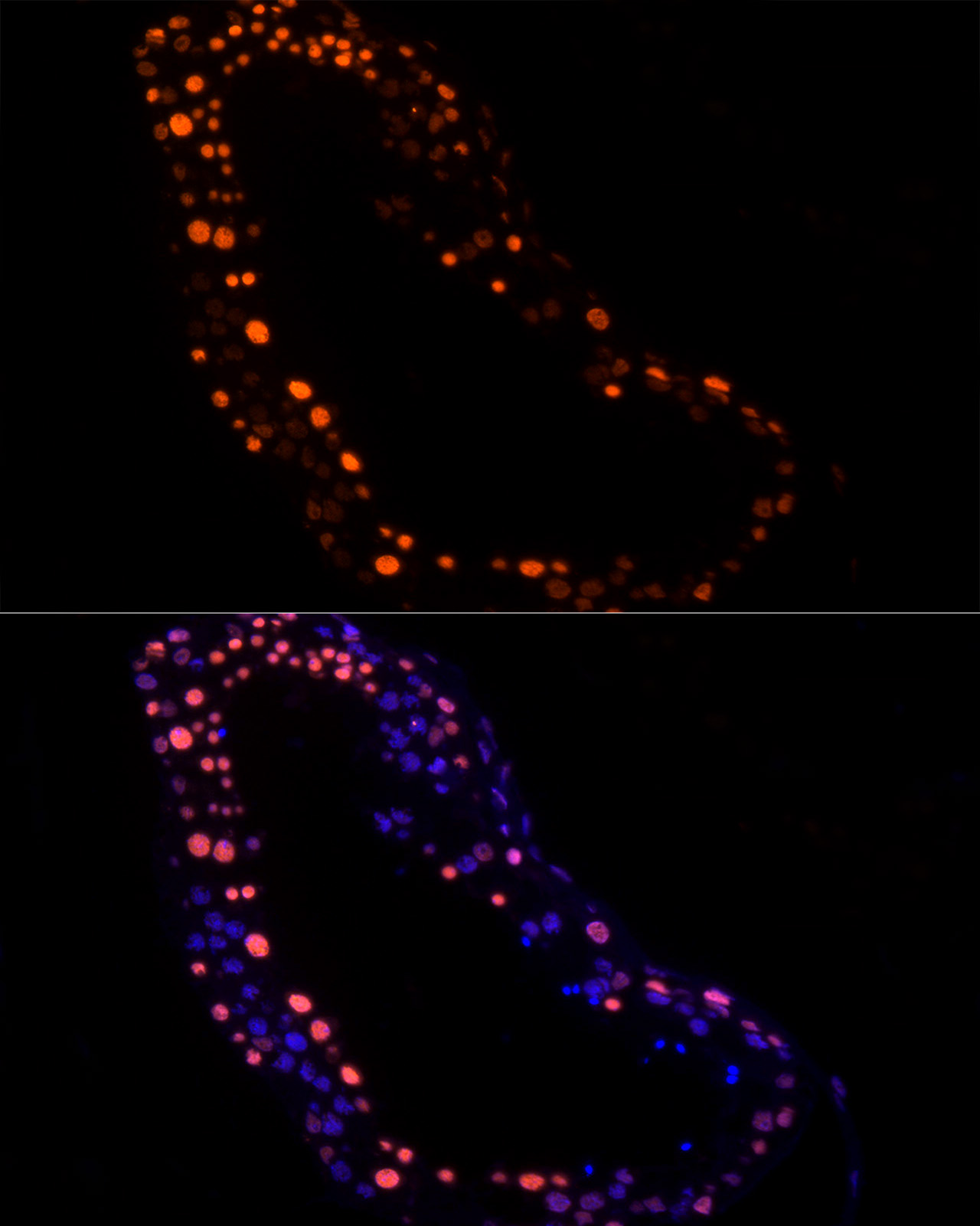
This gene belongs to the HNRPG subfamily of ubiquitously expressed heterogeneous nuclear ribonucleoproteins (hnRNPs). The hnRNPs are RNA binding proteins and they complex with heterogeneous nuclear RNA (hnRNA). These proteins are associated with pre-mRNAs in the nucleus and appear to influence pre-mRNA processing and other aspects of mRNA metabolism and transport. While all of the hnRNPs are present in the nucleus, some seem to shuttle between the nucleus and the cytoplasm. The hnRNP proteins have distinct nucleic acid binding properties. The protein encoded by this gene has two RRM domains that bind RNAs. This gene is intronless and is thought to be derived from a processed retroposon. However, unlike many retroposon-derived genes, this gene is not a pseudogene. The encoded protein has similarity to HNRPG and RBMY proteins and it is suggested to replace HNRPG protein function during meiotic prophase or act as a germ cell-specific splicing regulator. It primarily localizes to the nuclei of meiotic spermatocytes. This gene is a candidate for autosomal male infertility.
| Pack Size | 100ul, 1ml, 20ul |
|---|---|
| Applications | ELISA, IF/ICC |
| Host Species | Rabbit |
| Ig Isotype | IgG |
| Antibody Type | Monoclonal Antibody |
| Organism Species | Human |
| Product Synonyms | RBMXL2 |
| Observed Mol Wt | 43kDa |
| Alternative Names | HNRPGT; HNRNPGT; HNRNPG-T; RBMXL2 |
| Immunogen (Antigen) | Recombinant protein |
| Format | Liquid |
| Buffer Formulation | 0.05% BSA, 50% glycerol, PBS with 0.02% sodium azide, pH7.3 |
| Reactivity | Human |
| Uniprot ID | 27288 |
| Gene ID | O75526 |
| Potency (Clone Number) | ARC2922 |
| Purification | Antigen-specific affinity chromatography followed by Protein A affinity chromatography |
| Usage | For Research Use Only. Not for diagnostics or human use. |
| Shelf Life | 12 months at time of shipping |
| Shipping | Shipped in Dry Ice at -20 Degree Celsius |
| Storage | Store at -20 Degree Celsius. It is recommended to aliquot and store to avoid repeated freeze-thaw as it affects the stability of the antibody. |
| Research Areas | Cell Biology, Developmental Biology, Immunology |
| KD/KO Validated | KD Validated |
| Disclaimer | The data indicated herein are as indicated and validated in our laboratory. These reagents are for research use only and not for in-vitro diagnostics or human use. |
Related Products
-
![glucose-6-phosphate isomerase Rabbit Monoclonal Antibody [KD Validated]](https://www.kinesisdx.com/wp-content/uploads/2025/05/A4401_ARC0997_WB_01-370x444.jpg) Sale
Cancer
Sale
Cancerglucose-6-phosphate isomerase Rabbit Monoclonal Antibody [KD Validated]
Price range: $110.00 through $430.00 -
![GPX4 Rabbit Monoclonal Antibody [KD Validated]](https://www.kinesisdx.com/wp-content/uploads/2025/05/A11243_ARC0558-03_WB_01-370x444.jpg) Sale
Sale
-
![ATG7 Rabbit Monoclonal Antibody [KD Validated]](https://www.kinesisdx.com/wp-content/uploads/2025/05/A19604_ARC0083_WB_01-370x444.jpg) Sale
Sale
-
![KMT5A/SETD8 Rabbit Monoclonal Antibody [KD Validated]](https://www.kinesisdx.com/wp-content/uploads/2025/05/A4136_ARC0916_WB_01-370x444.jpg) Sale
Cell Biology
Sale
Cell BiologyKMT5A/SETD8 Rabbit Monoclonal Antibody [KD Validated]
Price range: $110.00 through $430.00 -
![LC3B Rabbit Monoclonal Antibody [KD Validated]](https://www.kinesisdx.com/wp-content/uploads/2025/05/A19665_ARC0144_WB_01-370x444.jpg) Sale
Sale
-
![CPT1A Rabbit Monoclonal Antibody [KD Validated]](https://www.kinesisdx.com/wp-content/uploads/2025/05/A22450_ARC51170-01_WB_03-370x444.jpg) Sale
Sale
Reviews
There are no reviews yet.