
This gene encodes a glycoprotein that is localized in the endoplasmic reticulum. It plays an important role in cell protection against oxidative stress, and in the regulation of redox-related calcium homeostasis. Mutations in this gene are associated with early onset muscle disorders, referred to as SEPN1-related myopathy. SEPN1-related myopathy consists of 4 autosomal recessive disorders, originally thought to be separate entities: rigid spine muscular dystrophy (RSMD1), the classical form of multiminicore disease, desmin related myopathy with Mallory-body like inclusions, and congenital fiber-type disproportion (CFTD). This protein is a selenoprotein, containing the rare amino acid selenocysteine (Sec). Sec is encoded by the UGA codon, which normally signals translation termination. The 3′ UTRs of selenoprotein mRNAs contain a conserved stem-loop structure, designated the Sec insertion sequence (SECIS) element, that is necessary for the recognition of UGA as a Sec codon, rather than as a stop signal. A second stop-codon redefinition element (SRE) adjacent to the UGA codon has been identified in this gene (PMID:15791204). SRE is a phylogenetically conserved stem-loop structure that stimulates readthrough at the UGA codon, and augments the Sec insertion efficiency by SECIS. Alternatively spliced transcript variants have been found for this gene.
Sale

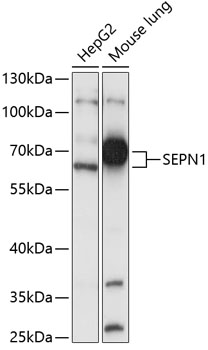
| Pack Size | 100ul, 1ml, 20ul |
|---|---|
| Applications | ELISA, WB |
| Host Species | Rabbit |
| Ig Isotype | IgG |
| Antibody Type | Polyclonal Antibody |
| Organism Species | Human |
| Product Synonyms | SEPN1 |
| Observed Mol Wt | 66kDa |
| Alternative Names | RSS; CFTD; SELN; CMYP3; MDRS1; RSMD1; SEPN1 |
| Immunogen (Antigen) | Recombinant protein |
| Format | Liquid |
| Buffer Formulation | 50% glycerol, PBS with 0.01% thimerosal, pH7.3 |
| Reactivity | Human, Mouse |
| Uniprot ID | 57190 |
| Gene ID | Q9NZV5 |
| Purification | Antigen-specific affinity chromatography followed by Protein A affinity chromatography |
| Usage | For Research Use Only. Not for diagnostics or human use. |
| Shelf Life | 12 months at time of shipping |
| Shipping | Shipped in Dry Ice at -20 Degree Celsius |
| Storage | Store at -20 Degree Celsius. It is recommended to aliquot and store to avoid repeated freeze-thaw as it affects the stability of the antibody. |
| KD/KO Validated | KD Validated |
| Disclaimer | The data indicated herein are as indicated and validated in our laboratory. These reagents are for research use only and not for in-vitro diagnostics or human use. |
Related Products
-
![Bcl-XL Rabbit Polyclonal Antibody [KD Validated]](https://www.kinesisdx.com/wp-content/uploads/2025/05/A22241_aP7267_KO-WB_01-370x444.jpg) Sale
Sale
-
![CTCF Rabbit Polyclonal Antibody [KD Validated]](https://www.kinesisdx.com/wp-content/uploads/2025/05/A18627_N6060-4_KO-WB_01-370x444.jpg) Sale
Sale
-
![CAT1 Rabbit Polyclonal Antibody [KD Validated]](https://www.kinesisdx.com/wp-content/uploads/2025/05/A25422_N32165-5_WB_01-370x444.jpg) Sale
Sale
-
![RHOT1/MIRO1 Rabbit Polyclonal Antibody [KD Validated]](https://www.kinesisdx.com/wp-content/uploads/2025/05/A22551_N1681810-11_WB_01-370x444.jpg) Sale
Cell Biology
Sale
Cell BiologyRHOT1/MIRO1 Rabbit Polyclonal Antibody [KD Validated]
Price range: $100.00 through $430.00 -
![COX7A2L Rabbit Polyclonal Antibody [KD Validated]](https://www.kinesisdx.com/wp-content/uploads/2025/05/A23681_N25896-4_WB_01-370x444.jpg) Sale
Sale
-
![Bcl9 Rabbit Polyclonal Antibody [KD Validated]](https://www.kinesisdx.com/wp-content/uploads/2025/05/A25229_N31416-5_WB_01-370x444.jpg) Sale
Sale
Reviews
There are no reviews yet.