
The protein encoded by this gene belongs to the pyridine nucleotide-disulfide oxidoreductase family, and is a member of the thioredoxin (Trx) system. Three thioredoxin reductase (TrxR) isozymes are found in mammals. TrxRs are selenocysteine-containing flavoenzymes, which reduce thioredoxins, as well as other substrates, and play a key role in redox homoeostasis. This gene encodes an ubiquitously expressed, cytosolic form of TrxR, which functions as a homodimer containing FAD, and selenocysteine (Sec) at the active site. Sec is encoded by UGA codon that normally signals translation termination. The 3′ UTRs of selenoprotein mRNAs contain a conserved stem-loop structure, the Sec insertion sequence (SECIS) element, which is necessary for the recognition of UGA as a Sec codon rather than as a stop signal. Alternative splicing, primarily at the 5′ end, results in transcript variants encoding same or different isoforms, including a glutaredoxin-containing isoform that is predominantly expressed in testis.
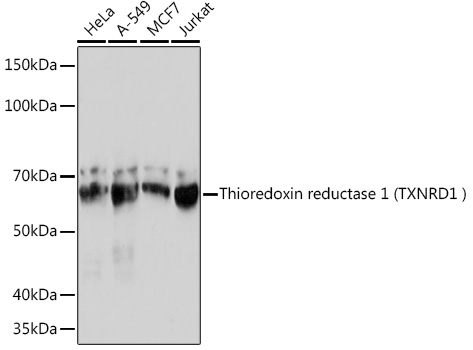
Human Thioredoxin Reductase 1/TRXR1 Rabbit Monoclonal Antibody
Price range: $110.00 through $430.00
| Pack Size | 100ul, 1ml, 20ul |
|---|---|
| Applications | ELISA, WB |
| Host Species | Rabbit |
| Ig Isotype | IgG |
| Antibody Type | Monoclonal Antibody |
| Organism Species | Human |
| Concentration | – |
| Product Synonyms | Human Thioredoxin Reductase 1/TRXR1 |
| Observed Mol Wt | 71kDa |
| Alternative Names | TR; TR1; TXNR; TRXR1; GRIM-12; Thioredoxin reductase 1 (TXNRD1 ) |
| Immunogen (Antigen) | Recombinant protein |
| Format | Liquid |
| Buffer Formulation | 0.05% BSA, 50% glycerol, PBS with 0.02% sodium azide, pH7.3 |
| Reactivity | Human, Mouse, Rat |
| Uniprot ID | 7296 |
| Gene ID | Q16881 |
| Potency (Clone Number) | ARC1106 |
| Purification | Antigen-specific affinity chromatography followed by Protein A affinity chromatography |
| Usage | For Research Use Only. Not for diagnostics or human use. |
| Shelf Life | 12 months at time of shipping |
| Shipping | Shipped in Dry Ice at -20 Degree Celsius |
| Storage | Store at -20 Degree Celsius. It is recommended to aliquot and store to avoid repeated freeze-thaw as it affects the stability of the antibody. |
| Research Areas | Cancer, Cell Biology, Immunology |
| KD/KO Validated | KD Validated |
| Disclaimer | The data indicated herein are as indicated and validated in our laboratory. These reagents are for research use only and not for in-vitro diagnostics or human use. |
Related Products
-
 Sale
Sale
-
![MRP4/ABCC4 Rabbit Monoclonal Antibody [KD Validated]](https://www.kinesisdx.com/wp-content/uploads/2025/05/A22601_ARC52223-01_WB_01-370x444.jpg) Sale
Sale
-
![EGFR Rabbit Monoclonal Antibody [KD Validated]](https://www.kinesisdx.com/wp-content/uploads/2025/05/A23452_ARC56230-01_KO-WB_01-370x444.jpg) Sale
Sale
-
![LC3B Rabbit Monoclonal Antibody [KD Validated]](https://www.kinesisdx.com/wp-content/uploads/2025/05/A19665_ARC0144_WB_01-370x444.jpg) Sale
Sale
-
![ERK1 Rabbit Monoclonal Antibody [KD Validated]](https://www.kinesisdx.com/wp-content/uploads/2025/05/A19561_ARC2591_WB_01-370x444.jpg) Sale
Sale
-
![Bid Rabbit Monoclonal Antibody [KD Validated]](https://www.kinesisdx.com/wp-content/uploads/2025/05/A23234_ARC59702-01_WB_01-370x444.jpg) Sale
Sale
Reviews
There are no reviews yet.