
Cadherin is one of a class of integral-membrane glycoproteins that are involved in cell to cell attachment for preserving the integrity of all solid tissues. Cadherins have three major regions: the Ca2+ -dependent extracellular region that mediates adhesion (cadherin to cadherin) for cell to cell binding; the transmembrane region; and the cytoplasmic region that extends into the cell and interacts with catenins, which in turn are linked to the actin of the cytoskeleton. Cadherins are differentially expressed during development and in adult organs. Since many cell types express multiple cadherin subclasses simultaneously (the combination differs with cell type), it can be inferred that the adhesion properities of individual cells are thus governed by varying the combinations of cadherins. Altered expression of cadherins are involved in invasion and metastasis of tumour cells. The classical cadherins (e.g. E-, N-, and P-cadherins) are the most common family members. E-cadherin (also known as uvomorulin) is concentrated in the belt desmosome in epithelial cells; N-cadherin is found in nerve, muscle, and lens cells and helps maintain the integrity of neuronal aggregates; P-cadherin is expressed in placental and epidermal cells.
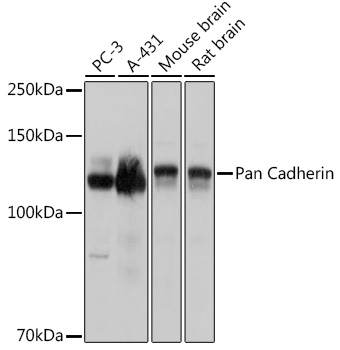
| Pack Size | 100ul, 1ml, 20ul |
|---|---|
| Applications | ELISA, IP, WB |
| Host Species | Rabbit |
| Ig Isotype | IgG |
| Antibody Type | Polyclonal Antibody |
| Organism Species | Human |
| Concentration | – |
| Product Synonyms | Pan Cadherin |
| Immunogen (Antigen) | synthetic peptide |
| Format | Liquid |
| Buffer Formulation | 50% glycerol, PBS with 0.01% thimerosal, pH7.3 |
| Reactivity | Human, Mouse, Rat |
| Uniprot ID | 999/1000/1001/1002 |
| Gene ID | P12830/P19022/P22223/P55283 |
| Purification | Antigen-specific affinity chromatography followed by Protein A affinity chromatography |
| Usage | For Research Use Only. Not for diagnostics or human use. |
| Shelf Life | 12 months at time of shipping |
| Shipping | Shipped in Dry Ice at -20 Degree Celsius |
| Storage | Store at -20 Degree Celsius. It is recommended to aliquot and store to avoid repeated freeze-thaw as it affects the stability of the antibody. |
| Research Areas | Cell Biology, Developmental Biology, Immunology |
| KD/KO Validated | KD Validated |
| Disclaimer | The data indicated herein are as indicated and validated in our laboratory. These reagents are for research use only and not for in-vitro diagnostics or human use. |
Related Products
-
![EIF4B Rabbit Polyclonal Antibody [KD Validated]](https://www.kinesisdx.com/wp-content/uploads/2026/10/KDXB200038_1.jpg) Sale
Sale
-
![CTCF Rabbit Polyclonal Antibody [KD Validated]](https://www.kinesisdx.com/wp-content/uploads/2026/10/KDXB200025_1.jpg) Sale
Sale
-
![COX7A2L Rabbit Polyclonal Antibody [KD Validated]](https://www.kinesisdx.com/wp-content/uploads/2026/10/KDXB200023_1.jpg) Sale
Sale
-
![ABCA6 Rabbit Polyclonal Antibody [KD Validated]](https://www.kinesisdx.com/wp-content/uploads/2026/10/KDXB200005_1.jpg) Sale
Sale
-
![COX IV Rabbit Polyclonal Antibody [KD Validated]](https://www.kinesisdx.com/wp-content/uploads/2026/10/KDXB200022_1.jpg) Sale
Sale
-
 Sale
Sale
Reviews
There are no reviews yet.