
This gene is located within the Prader-Willi Syndrome critical region on chromosome 15 and is imprinted and expressed from the paternal allele. It encodes a component of the small nuclear ribonucleoprotein complex, which functions in pre-mRNA processing and may contribute to tissue-specific alternative splicing. Alternative promoter use and alternative splicing result in a multitude of transcript variants encoding the same protein. Transcript variants that initiate at the CpG island-associated imprinting center may be bicistronic and also encode the SNRPN upstream reading frame protein (SNURF) from an upstream open reading frame. In addition, long spliced transcripts for small nucleolar RNA host gene 14 (SNHG14) may originate from the promoters at this locus and share exons with this gene. Alterations in this region are associated with parental imprint switch failure, which may cause Angelman syndrome or Prader-Willi syndrome.
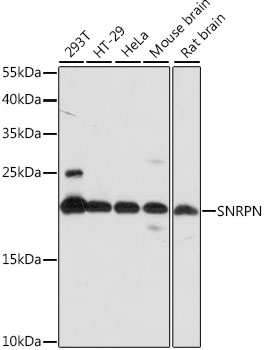
| Pack Size | 100ul, 1ml, 20ul |
|---|---|
| Applications | ELISA, WB |
| Host Species | Rabbit |
| Ig Isotype | IgG |
| Antibody Type | Polyclonal Antibody |
| Organism Species | Human |
| Product Synonyms | SNRPN |
| Observed Mol Wt | 25kDa |
| Alternative Names | SMN; PWCR; SM-D; sm-N; RT-LI; HCERN3; SNRNP-N; SNURF-SNRPN; SNRPN |
| Immunogen (Antigen) | synthetic peptide |
| Format | Liquid |
| Buffer Formulation | 50% glycerol, PBS with 0.01% thimerosal, pH7.3 |
| Reactivity | Human, Mouse, Rat |
| Uniprot ID | 6638 |
| Gene ID | P63162 |
| Purification | Antigen-specific affinity chromatography followed by Protein A affinity chromatography |
| Usage | For Research Use Only. Not for diagnostics or human use. |
| Shelf Life | 12 months at time of shipping |
| Shipping | Shipped in Dry Ice at -20 Degree Celsius |
| Storage | Store at -20 Degree Celsius. It is recommended to aliquot and store to avoid repeated freeze-thaw as it affects the stability of the antibody. |
| Research Areas | Cell Biology, Developmental Biology, Immunology |
| KD/KO Validated | KD Validated |
| Disclaimer | The data indicated herein are as indicated and validated in our laboratory. These reagents are for research use only and not for in-vitro diagnostics or human use. |
Related Products
-
![COX7A2L Rabbit Polyclonal Antibody [KD Validated]](https://www.kinesisdx.com/wp-content/uploads/2025/05/A23681_N25896-4_WB_01-370x444.jpg) Sale
Sale
-
![DNMT1 Rabbit Polyclonal Antibody [KD Validated]](https://www.kinesisdx.com/wp-content/uploads/2025/05/A16729_aN2135-5_WB_04-370x444.jpg) Sale
Sale
-
![ABCA6 Rabbit Polyclonal Antibody [KD Validated]](https://www.kinesisdx.com/wp-content/uploads/2025/05/A21243_Q12592_WB_01-370x444.jpg) Sale
Sale
-
![EGFR Rabbit Polyclonal Antibody [KD Validated]](https://www.kinesisdx.com/wp-content/uploads/2025/05/A21740_aN1626-7_WB_01-370x444.jpg) Sale
Sale
-
![DIAPH1 Rabbit Polyclonal Antibody [KD Validated]](https://www.kinesisdx.com/wp-content/uploads/2025/05/A18081_N17470-4_KO-WB_01-370x444.jpg) Sale
Sale
-
![COMT Rabbit Polyclonal Antibody [KD Validated]](https://www.kinesisdx.com/wp-content/uploads/2025/05/A23600_N27285-4_WB_01-370x444.jpg) Sale
Sale
Reviews
There are no reviews yet.